One decade later, Minecraft world generation is interesting again
Note: This article was updated in April 2026
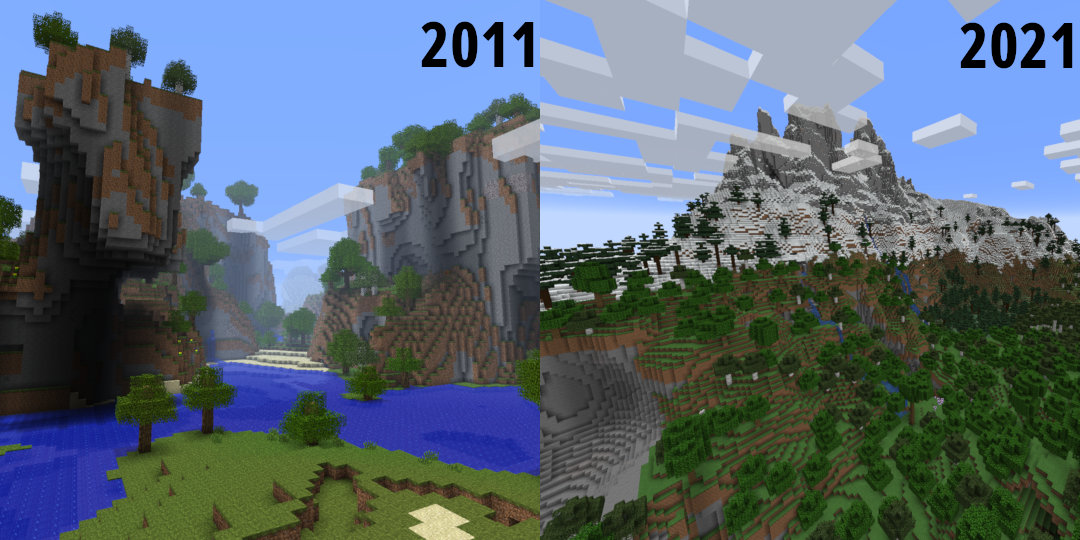
I became a big fan of Minecraft when I first started playing it in early-2011. I have stopped in recent years since I find it dangerously addictive, though I sometimes keep up with the new changes. Today I want to look back at a development mistake that was made in Beta 1.8, one that took a decade to recover from.
In the b1.8 update, the terrain generator was subject to a complete rewrite aimed to make the code simpler. This was back in September 2011, the game was nowhere near as popular as it is today, only a small portion of today's players even know about it. But at the time it caused quite a controversy, a thread on the Minecraft Forums decried the new terrain as "boring", and quickly became the most replied topic on the site.
When biomes were first introduced into the game, terrain height, biome placement, and even foliage tint was influenced by a climate system. In other words the terrain influenced the biome. This was reversed in Beta 1.8, now biomes would control everything. Out of what I can only assume was an attempt to make the land more realistic, nearly every biome was made flat, except for one called "Extreme Hills", a biome with a dull green colour and little flora. Looking at the forum post's comparison image between b1.7 and b1.8 demonstrates why many found this new system boring.

It may seem like a small complaint, but world exploration is a big part of the game. I can say that for me, I stopped playing survival after this update, preferring multiplayer creative with my friends.
Mojang were initially not very open to criticism, though, the worst issues were addressed in October 2013 for the 1.7.2 update. In this update, most biomes received variants, which would allow more vertically interesting land formations. And some biomes that were previously removed in b1.8 were re-added. Also worth mentioning that the "Mountains" biome replaced "Extreme Hills" and resembled a realistic mountain.
This update was a massive improvement, but I still felt something was missing. Life moved on, but every time I returned to playing the game, I felt the terrain was held back.
A few years ago I decided to poke around with Luanti (known then as Minetest), an open-source Minecraft-style engine. The worlds here were far more interesting, flat land was just a possible as very tall mountains, and the cave systems were massive. I realised an important technical difference.
Minecraft worlds stretch far and wide in the X and Z axis, but what's odd is that the Y axis (up and down) is limited to only 256 blocks. I believe Mojang didn't want the terrain to generate near the build limit, so the "Mountains" biome needed a limit, and the variant biomes couldn't be taller than the main "Mountains" biome. This limit is likely the reason why Minecraft worlds were so uninteresting vertically speaking.
In Luanti, the limit is far higher (16,000 if I remember correctly), so the limit for mountains is set much higher, and this is why the caves are so much larger. (Side-note: The caves in this new update very closely resemble those in Luanti.)
I also believe Luanti's terrain generation and biome system is more similar to old-school Minecraft, as many biomes can have large mountain structures, though this will depend on what base game and mods are used.
So I was quite pleased to hear that a "Caves and Cliffs" update was planned for 2021.
I decided to look at 1.18 (the "Caves and Cliffs" update), and I am very impressed.
It's now common to find interesting looking hills in most biomes now. And if you search (about 3-5 minutes of flying), you can come across significant mountain ranges, all looks good. I also noticed a few new biomes for these mountains as well, some of them quite lush.
And if you search on the internet, you can find very impressive screenshots of this new terrain.
To top it all off, Mojang have introduced a chunk blending feature. So that old worlds can blend nicely with the new, rather then creating a harsh cutoff.
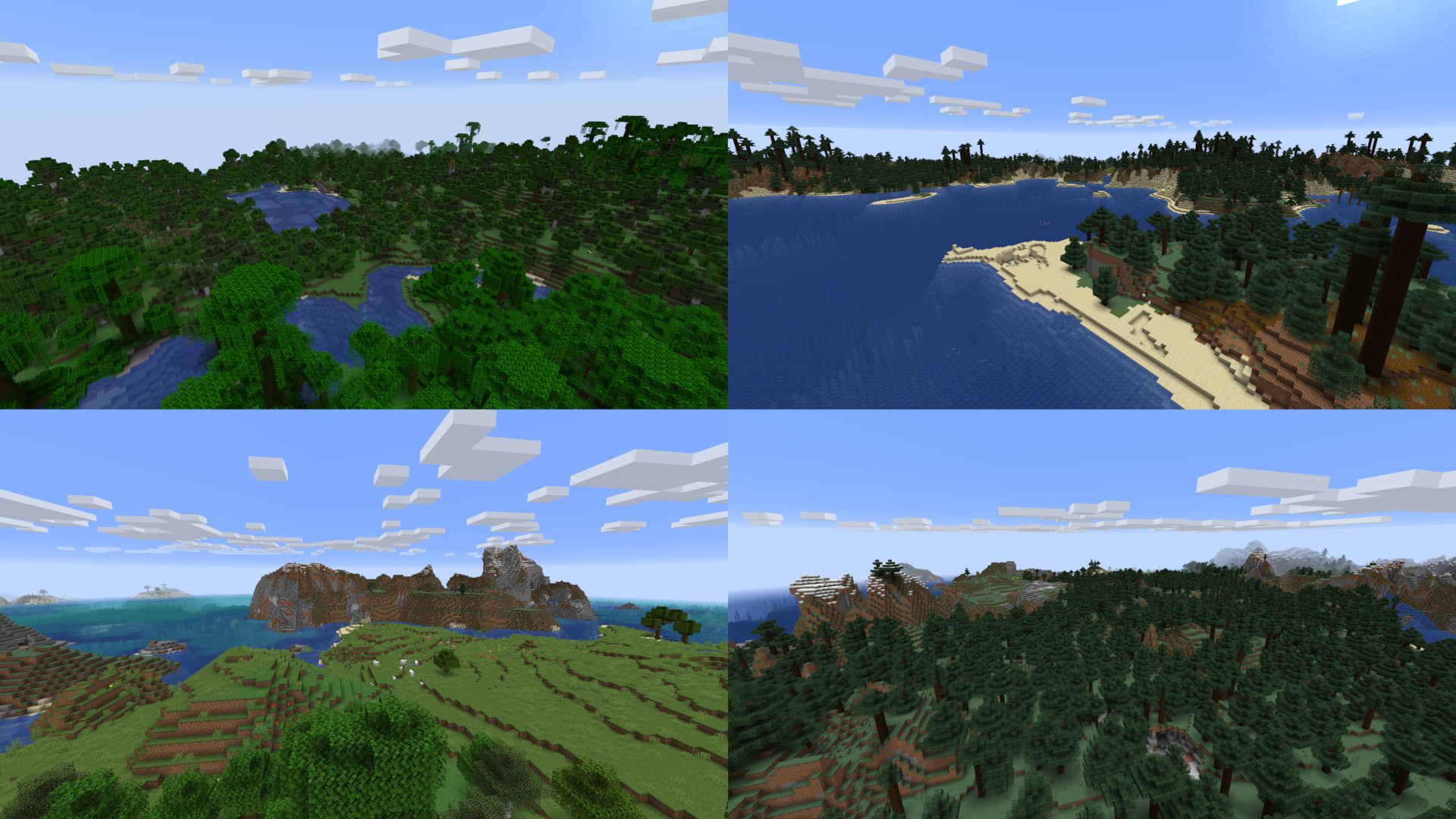
Of course, I should probably show you what I'm talking about. I created 4 new worlds on 4 Minecraft versions to show off each iteration. I took the screenshot at the spawn point, except for 1.18, since I wanted to show off the mountains.
Alpha 1.2.0 — Beta 1.7.3
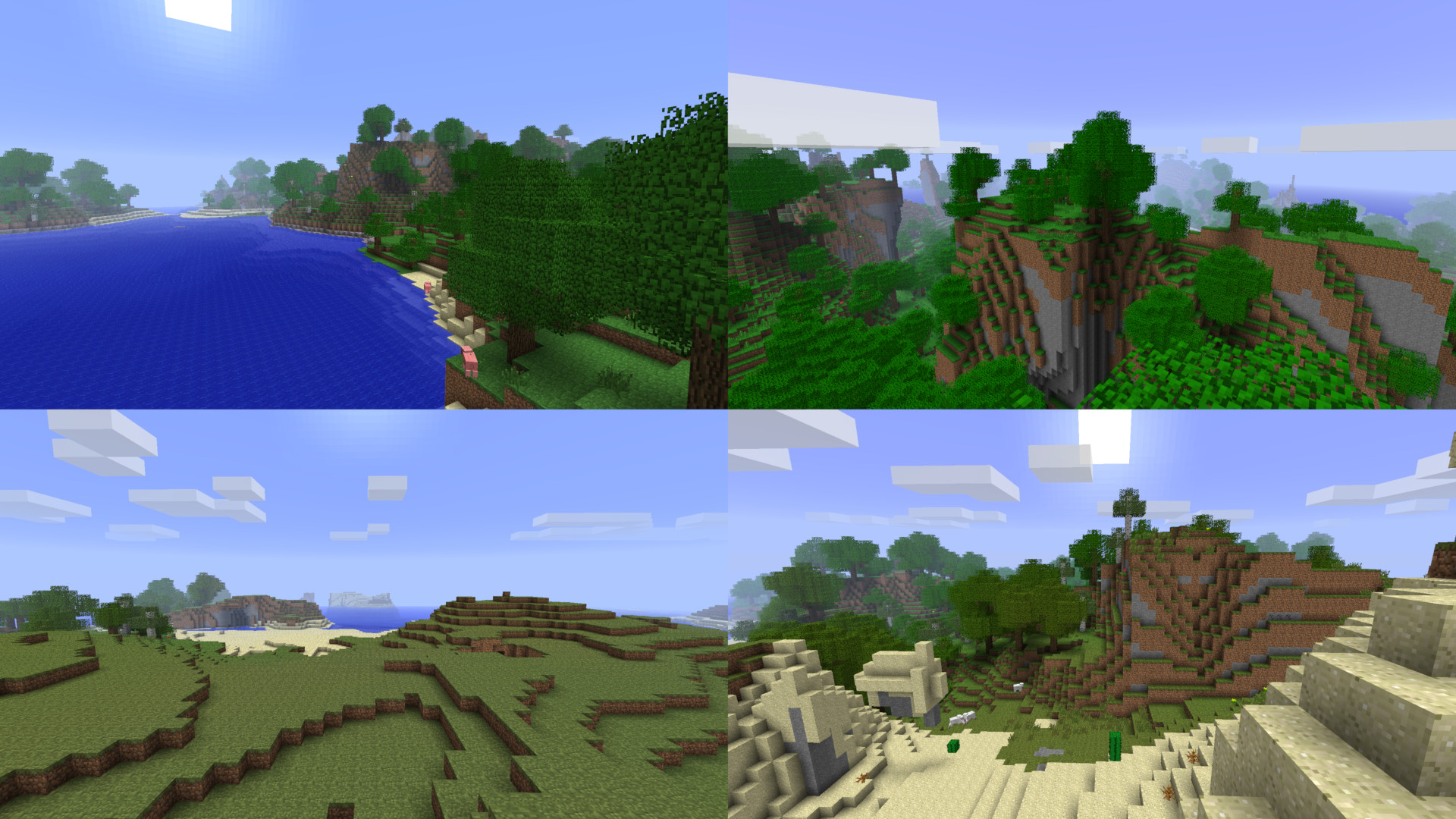
For the longest time, I've considered this the golden standard of Minecraft terrain generation. Worlds are lush, varied, and interesting. Though I am aware of some drawbacks, for instance, ocean size is roughly 50/50 with land. This world-gen was first introduced in Alpha 1.2.0, and remained fairly stable throughout.
The climate system, broken into into temperature + rainfall values, plays a bigger role than biomes, even determining biome placement.

Taller mountains are more common in high rainfall areas, and temperature determines foliage colour. Biomes only determine terrain features in this version.
Biome differences aren't as stark as they are in newer versions—It's sometimes hard to tell where one starts and ends. This ultimately makes the worlds feel more cohesive than anything that came later. On the other hand, biomes such as "Rainforest" and "Seasonal Forest" make no sense compared to how biomes are treated in the current version of the game.
For those that don't already know, terrain generation layers here and almost everywhere else use Perlin noise. When multiple layers of Perlin noise are added to itself in a fractal arrangement, this is known as "Fractal Brownian Motion (fBm)". Minecraft has always used this on much of it's layers, and these layers shape or modify the terrain, climate map included. Understanding the math isn't important, but understanding the application (and the generation pipeline) that matters the most.
Beta 1.8 — 1.6.4
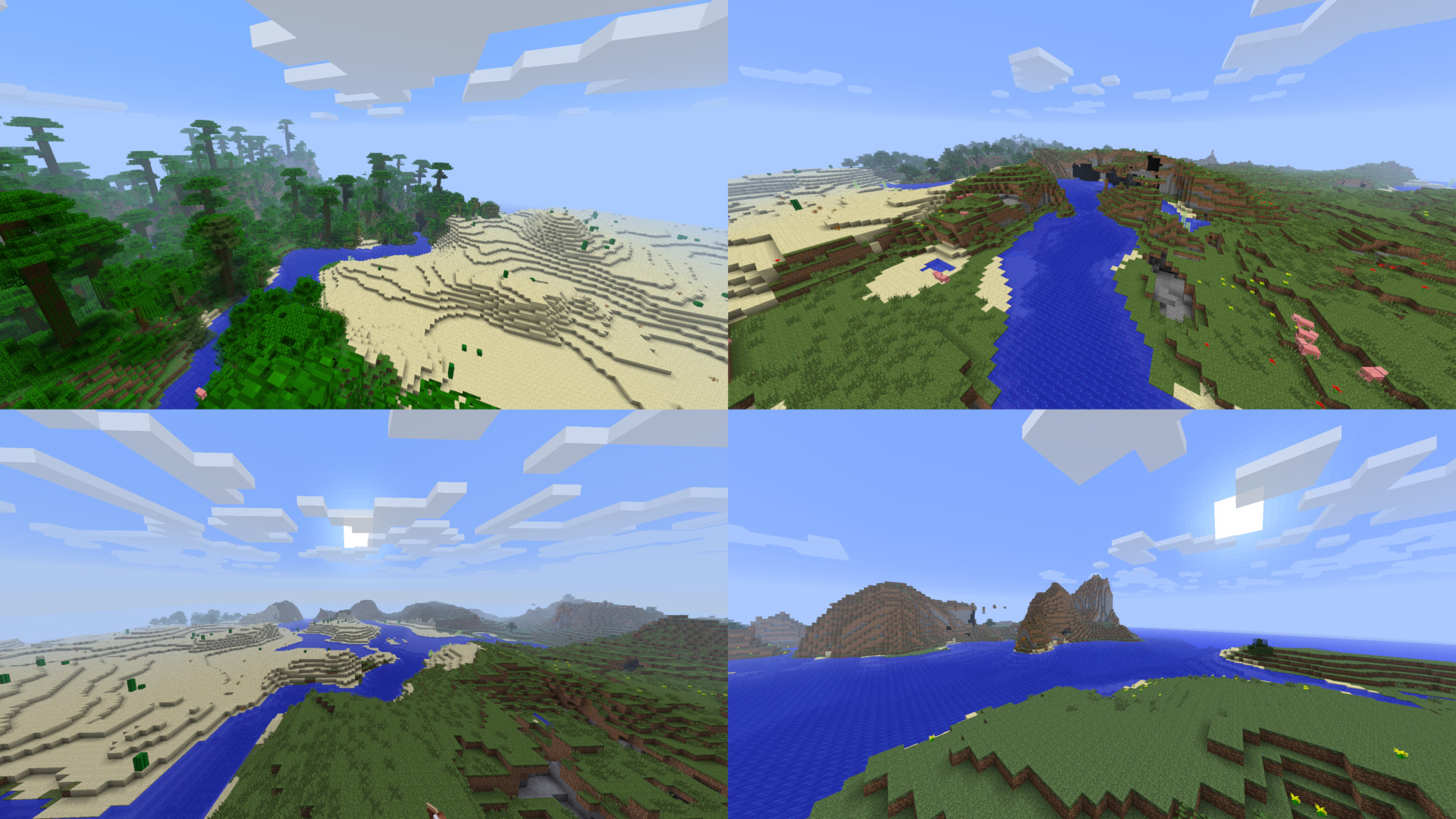
Beta 1.8 overhauled the system, and now biomes determine everything. The biome-map is generated using a fractal algorithm, and the climate system is apparently gone. There are advantages to a "biomes cause terrain" system. But I feel this iteration was unfinished, and result was the most bland Minecraft ever had.
The system was overhauled again between Beta 1.8 and 1.0, and was tweaked a number of times after, mostly adding new biomes. Some of the new biomes here were a welcomed addition, such as the Spruce Forest, and Oceans. This marked a change where each biome would have a more distinct look and identity.
An important thing to point out here are oceans. Pre-b1.8, as I mentioned, was often criticised for lacking sizeable oceans. Beta 1.8 and onwards moved to continental terrain where landmasses were surrounded by ocean. But this was also criticised for ocean being too large.
To be fair they did tend towards being large on some seeds. But given the interest in continental terrain nowadays, I'd say it's a good but poorly executed idea here.
1.7.2 — 1.17.1
With 1.7.2, "The Update that Changed the World", things improved a lot with many new biomes added, and some reintroduced. I would say this is the biggest step up in terms of environment variety.
They kept the same concept going back to Beta 1.8 where the biome determines terrain. But added some improvements, such as a better climate system which stopped the issue where, for example, deserts could spawn next to humid snow biomes which would sometimes happen from Beta 1.8.
To avoid the terrain being too flat, a lot of hill and "modified" variants of biomes were introduced. Ocean size was also reduced, as additional landmasses get added during the lower layers of the fractal map generation.
I think there is a fundamental issue having terrain height tied to the biome zoning, as natural structures like mountains are of that biome and sticks out compared to the wider landscape. It also isn't common to see more than one biome on a single mountain. I think this image on the Minecraft Wiki shows this zoning effect well enough.

1.18+
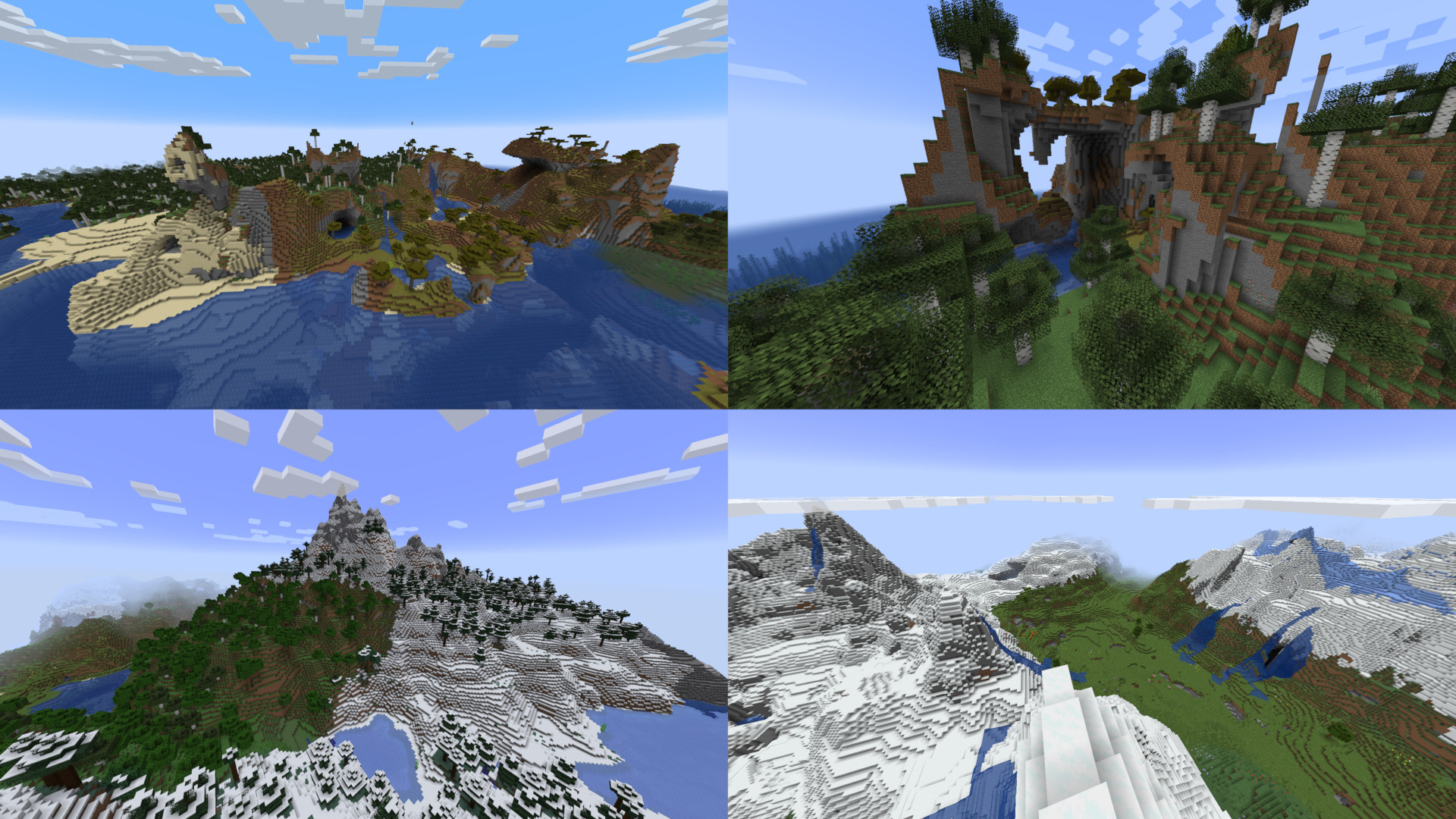
The "Caves and Cliffs" update presents the first truly exciting terrain generator since the game went 1.0. These screenshots are cherry-picked to show off the mountains. There is also plenty of flat land that resembles what came before.
In this version the terrain is independent of biome placement. But unlike Beta 1.7.3 and earlier, it uses a much more complex noise generation system with multiple layers of noise which shape the terrain, with these values then being routed into a separate biome placement system. I suggest watching Henrik Kniberg's presentation (26mins), and his talk (50mins) to fully grasp this system, as he does a very good job explaning.
A variety of mountain and cave biomes were introduced to provide variation. These are all good. I should also point out that vast and massive caves are very fun to explore. And make it a solid alternative to repetitive/mindless mining.
I think compared to Beta, the world is more realistic, without compromising variety. Waterways and oceans are more consistent. I still think Beta is more cohesive thanks to it's approach to biomes, and I think it's simplicity and surrealism make it still fun to play on.
Compared to b1.8 to 1.16.5 the landscape seems more "vast" for different reasons than b1.7.3. I think it has to do with generating larger mountain shapes, without locking it to a biome zone, more than one biome can then appear on the mountain.
Oceans were never made large again. If that is preferred with your play-style, the "Large Biomes" option on Java, and apparently datapacks allow you to change this.
Changelog
2026-04-26
I figured I'd come back and update this article since I got a few things wrong that I've since learned more about, and I don't plan on writing anymore about Minecraft terrain generation.
- Completely rewrote the breakdown of each version
- Add much more technical detail, not just short observations
- Made my tone on the size of the oceans in b1.8 more neutral (previously I said they were always too big)
- I didn't mention the pre-b1.8 temp/rainfall values before in the beginning of the article
- Re-wordings at the beginning of the article
- Reflect Minetest is now called Luanti
- Elaborate more on Luanti's terrain generation
- Add some new links
2022-03-30
- Changed grammar in title.
- Removed line about b1.8 terrain changed to make it more realistic. We don't know this was the intention for sure, and was just an interpretation at the time.
- Fixed slight mistakes.
- Re-writes in Comparisons.